




I need to tell you about some men.
Specifically, I need to tell you about three fictional fathers who appeared on American television between 1998 and 2006, on a network called The WB, and who collectively did something to me that I am only now fully equipped to name. I was in my twenties. I was in Santiago. I was slowly — very slowly, in the way that feels less like a process and more like a dawning — coming out to myself. And these men were on my screen, being handsome and emotionally available and complicated in ways that men on television simply weren't supposed to be yet.
I didn't know what I was registering. I just know I kept watching.
The Setup: Santiago, A Cable Channel, and Subtitles
Let me place you in the scene. Late nineties into the early 2000s. Santiago, Chile. I was born in 1977, so you do the math — I'm a Gen-Xer, which in Latin America means something slightly different than it does in the United States. My teenage years were soundtracked by The Cure and The Smiths, yes, but also by Soda Stereo and Virus. My MTV was MTV Latino. I consumed American pop culture the way you consume something transmitted from a great distance — with passion and a slight delay, filtered through another context, arriving slightly transformed.
American television came to us on cable — specifically, via The WB, a US network that specialized in a very particular kind of prestige drama: small towns, big feelings, teenagers with vocabulary far beyond their years, and — crucially — adults who were interesting. More than background characters or comic relief; but actual people with inner lives. This was not always the norm. Television dads, historically, had been props. The WB kept casting them as protagonists.
In Latin America, The WB arrived as El Canal Warner — WBTV — and I can still feel what it was like to find it on the dial. What I know for certain is that these shows arrived subtitled, not dubbed. This matters more than it might seem. Subtitles mean you hear the actual voices. You hear the rhythm of the speech, the texture of it, the pauses. You are not watching a translated approximation of the performance — you are watching the performance itself, reading along. It's a more intimate way to receive a show than dubbing, in a strange way. You're closer to the thing.
I watched. I felt things I didn't have words for. I kept watching.
Mitch Leery, And The Ghost of The Flash
Dawson's Creek ran from 1998 to 2003. If you've never seen it: a precocious, film-obsessed teenager named Dawson Leery lives in the fictional town of Capeside, Massachusetts, navigating adolescence, first love, and an almost pathological need to process everything out loud. It is extremely sincere in a way that was slightly embarrassing even at the time and has since become charming. I loved it.
But I want to talk about the father.
Mitch Leery was played by John Wesley Shipp. If that name makes you do a double-take — good. It should. Because before he was Dawson's dad, John Wesley Shipp was The Flash. The original one. The 1990 CBS television series where he wore the red suit and the square jaw and fought crime in a way that was impossible to watch without registering that this was a very handsome man in a very tight suit. I was thirteen in 1990. I registered it. I didn't know what to do with the registration.
Eight years later he reappears, now a father on The WB, and somehow — somehow — has become more attractive. This is the kind of thing that happens to certain men and it is deeply unfair to the rest of us.
Mitch Leery was a former high school football star who gave up a more ambitious life to be present for his family and eventually opened a restaurant in Capeside. On paper this sounds ordinary. On screen it was revolutionary, because Mitch Leery was emotionally available in a way that television fathers almost never were. He took Dawson's filmmaking seriously. He talked to his son like his son was a person whose interior life mattered.
And then there was the marriage. Mitch and Gale were not a matched set of parental furniture — they were a real couple, with a real history and real damage. She had an affair. They tried to repair it, the way people do when there's enough love left to make the attempt worthwhile, and enough hurt to make it genuinely hard. They split. The show didn't look away from any of it. For a teenager's drama on The WB, Dawson's Creek had a surprisingly honest portrait of what it actually costs to stay with someone, or to leave them.
He was also broad-shouldered and warm-eyed and I was twenty-one years old watching him on a screen in Santiago and something in my chest was doing a thing I didn't have a name for.
I'll spare you the full spoiler, but I will say this: Mitch Leery doesn't make it to the end of the series. A car accident. Sudden, as those things are. The show handled his absence the way it handled everything — with more feelings than seemed possible in the available airtime. I wasn't prepared for it then, and I'm not sure I would be now. That's how present he was. That's how much it mattered, even from thousands of miles away, even in subtitles, even in a life where I hadn't yet figured out exactly what I was mourning when a man like that disappeared from a screen.
Luke Danes, Flannel, and the Fastest Talkers on Television
Gilmore Girls premiered in 2000 and it is — I will die on this hill — one of the greatest television shows ever made. Stars Hollow, Connecticut. Lorelai Gilmore and her daughter Rory. A mother-daughter relationship so specific and warm and funny that it made people around the world feel, briefly, like they were in it. A whole town functioning as chosen family. And dialogue — the dialogue — delivered at a pace that I have seen American viewers describe as exhausting and I have always found completely, naturally comfortable.
Here's the thing about Chileans that the rest of the world knows and we know about ourselves: we speak fast. We drop syllables. We compress. We talk at a clip that startles people who are meeting us for the first time. So when Lorelai Gilmore opened her mouth and a hundred and fifty words came out in twelve seconds, I did not reach for the remote. I leaned forward. This is just how people talk.
Into this verbal hurricane walked Luke Danes.
Scott Patterson. Flannel shirt. Backwards baseball cap. An expression of mild exasperation that somehow read as affection. Luke ran the diner at the center of Stars Hollow, opened before dawn because Lorelai needed her coffee and he had decided, without ever quite saying so, that making sure she had it was part of his reason for being. He was the still point at the center of all that dazzle. The man who did not talk fast, because he was too busy actually doing things.
And the forearms. I'm going to talk about the forearms. The show was not shy about Scott Patterson's forearms and neither am I.
What made Luke interesting — what made him extraordinary, actually — is that for much of the series he isn't technically a father. He's a father figure. He shows love entirely through acts of service. He fixes things. He shows up. He never says the thing, but he does the thing, every time, without being asked. For someone who grew up watching men perform emotional unavailability as though it were a form of strength, Luke Danes was a quiet and sustained argument that there was another way. That you could be strong and silent and deeply, consistently caring. That the two things were not in contradiction.
I was watching this from Santiago, in subtitles, hearing Scott Patterson's actual voice — low, slightly gruff, the kind of voice that belongs to a man who means what he says and doesn't say much. I was in my mid-twenties. I was figuring something out.
Andy Brown, and the Power of a Preview
I have to be honest with you about something: I never actually watched Everwood.
I know. I know. But hear me out, because I think my relationship with this show might be more interesting than if I had watched it.
Everwood premiered on The WB in 2002. Here is what I know secondhand, from years of cultural osmosis and the kind of research you do when you're finally writing the essay you've been meaning to write for twenty years: Dr. Andrew Brown is a brilliant, famous neurosurgeon in New York City. His wife dies. In grief, in guilt, in some desperate attempt to become a different and better man, he packs up his two kids and moves them to Everwood, Colorado — a tiny mountain town where he intends to practice medicine, for free, and figure out who he is without the career and the city and the life he built. It is, by all accounts, a beautiful and devastating show. I will watch it. Eventually.
But what I did have was the previews.
Thirty seconds. Maybe sixty. Running before or after something else I was watching, on whatever channel this was, in Santiago. And in those thirty seconds: Treat Williams. Bearded. Grief in his face but not broken by it — weathered by it, which is a different thing. Tall. Distinguished in a way that didn't ask for your attention but held it regardless.
I did not know this man's name. I did not know the plot of the show. I did not need any of that information to understand that something was happening in my chest when he appeared on screen. The desire existed independent of the narrative. The pull was complete before I had any context for it.
I think this is one of the most honest things I can tell you about what it was like to be a young queer man who didn't have the word queer yet. You didn't need the whole story. You just needed the image. The feeling arrived first, fast and clear, and the understanding came later — much later, in my case — like a translation you didn't know you were waiting for.
Treat Williams deserved more flowers than he got for that role. So does the show. And so, honestly, does the version of me in Santiago who watched thirty seconds of a preview and felt something true.
What These Men Were Actually Saying
All three of these shows were on The WB. All three aired within eight years of each other. All three featured, at their center, a man who felt things and didn't perform numbness about it. Who showed up. Who was complicated in ways that male characters on television were rarely permitted to be. Mitch Leery, who took his son's dreams seriously. Luke Danes, who loved through presence and action, quietly and completely. Andy Brown, who lost everything and chose to become someone worthy of what he'd lost.
This was not the dominant model of masculinity on offer in 1998, or 2000, or 2002. These men were doing something new, or at least something newly visible. And for a young man in Santiago, watching on a cable channel he can't quite name, reading subtitles, slowly and quietly becoming — these fictional fathers were modeling something. Showing a version of manhood that had room in it. Room for feeling. Room for presence. Room for showing up, even imperfectly, even late.
Also they were extremely attractive and I will not be separating these two facts.
The Wilmington Postscript
Here is the part of this story that still makes me smile every time I think about it.
Years after those nights in Santiago, I moved to North Carolina. I was living in Chapel Hill. My boyfriend — now my husband — was living in Wilmington, two hours east, and I would drive out to see him as often as I could. At some point during those visits I learned something that stopped me mid-sentence: Wilmington is where Dawson's Creek was filmed. The fictional Capeside, Massachusetts — the waterfront town where Mitch Leery opened his restaurant and Dawson processed his feelings at great length and I sat in Santiago watching it all unfold — was actually the streets and docks of Wilmington, NC. The show I had watched from the other side of the world was made in the city where my boyfriend was living while I was falling in love with him.
They call Wilmington "Wilmywood," by the way. Enough television and film has been shot there over the years that the nickname stuck. I did not know this before I started visiting. I learned it the way you learn things about a place when someone you love lives there — gradually, through accumulated details.
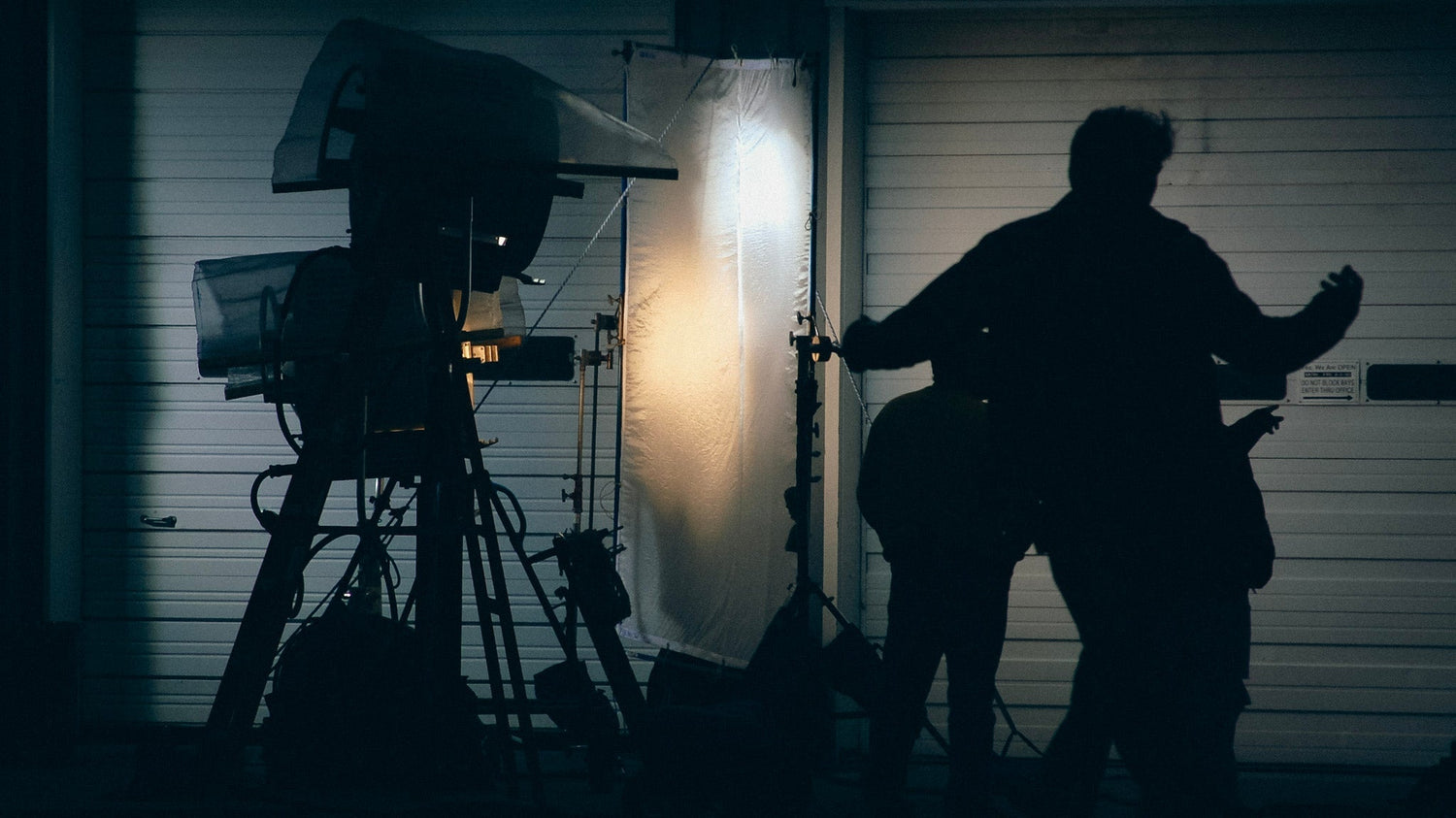
One of those details arrived at our friend's house. I was visiting when a production crew showed up directly across the street from his house and began turning the building into a fictional auto shop. They were filming an episode of One Tree Hill — another WB show, also set in a fictional North Carolina town, also made in Wilmington. I had never watched a single episode of One Tree Hill. I still haven't. But I stood there, a recent immigrant from Santiago, Chile, watching cameras and lights and crew members transform an ordinary street into a television set, and I felt something that I can only describe as wonder. I had my camera with me. The photo at the top of this post is from that night. This is how it's made. This is the machine behind the thing I used to watch from so far away.
And one of our friends, it turned out later, had been an extra in the very first episode of Dawson's Creek.
The world is small and strange and occasionally generous in this specific way, where the things you longed for from a distance turn out to have been closer to your real life than you ever could have known. Mitch Leery was in Wilmington. My husband was in Wilmington. A friend of ours walked through the background of the first episode before we'd ever met him. And I was in Santiago, watching El Canal Warner, feeling something I didn't have the words for yet.
I have the words now.
If you're reading this and you know exactly what I mean — if you watched these men on a screen somewhere and felt something land before you had a name for it — this is for you. The Hunky Tribe has always been made of people who figured it out in their own time, in their own city, in their own language. Welcome.
Stay Hunky.