

Heads up: spoilers ahead for all five episodes of Tip Toe. If you haven't watched it yet, bookmark this and come back.
My husband and I finished Tip Toe the other night, and it left us feeling depressed. A bit nauseous. A bit scared.
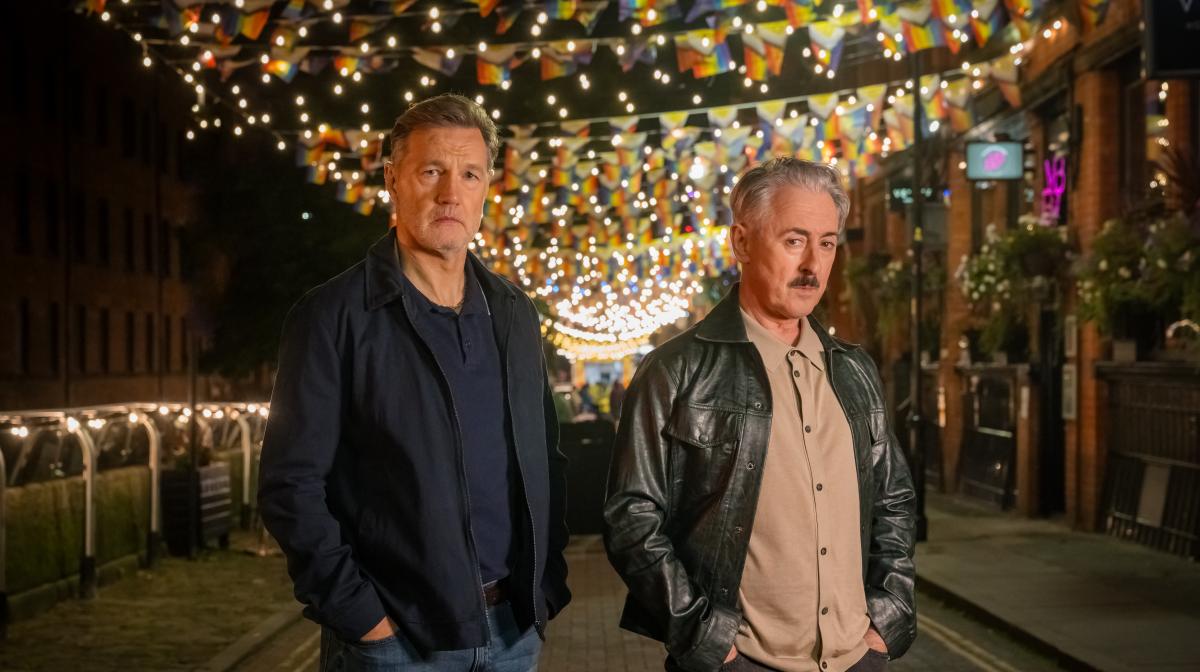
If you missed it: it's Russell T Davies's five-part Channel 4 drama. Alan Cumming plays Leo, a gay bar owner on Canal Street. David Morrissey plays Clive, the electrician next door. Over five episodes the two of them curdle from neighbors who tolerate each other into something much worse, fed by the stuff we all marinate in now. The scrolling. The rage. The lies that get a little louder every year. And it ends with Leo hanged from a lamppost outside his own front door.
Here's the part that wrecked me. The show tells you that in the first scene of the first episode. You watch the whole thing already knowing where it's going.
I kept waiting for the reversal
The entire time, some part of me was bargaining. It won't really be Clive. Leo will get out. Somebody will come to their senses before the last episode. I wanted the twist. I wanted the show to pull the rug and tell me it was all going to be fine.
It never did. And somewhere around episode four I realized why that hurt so specifically. I wanted to be lied to. I wanted the comfortable, dishonest ending, the same way propaganda has spent years telling everyone the comfortable lie that suited them. The show knew better than to lie to me. It respected me too much for that. That honesty is the most painful thing about it, and probably the most important.
The pendulum I've always believed in
I have a theory I've carried around for most of my adult life. I’ve mentioned it in passing in my videos on YouTube. Acceptance moves like a pendulum. It swings hard one way, then hard the other, and over time it more or less balances out. We get a bad stretch, then a better one. Progress, backlash, progress again. Give it time and it settles.
In episode one, Davies hands my exact theory to Leo. He says it almost word for word:
"Yeah, but it'll swing back. We do this, we go through history, we swing one way, we swing the other. Conservative then Labour, Republicans then Democrats. Just give it time, it'll... it'll settle."
Watching that, I felt caught. That's me. That's the thing I say to friends when the news gets ugly. And the show already told me, at the very top of the episode, that the man saying it ends up dead on a lamppost. How am I supposed to feel about that?
Melba wasn't having it
Leo says this to Melba, the drag queen who holds court at his bar, and she takes the whole idea apart in about thirty seconds:
"I think history's merciless. And it only goes one way. Onwards. It marches on, and on, and on, and what if this never swings back?... Because they hate us, Leo. They really hate us. And do you know what? I think they've always hated us. Only now they don't have to pretend anymore."
The pendulum, or the march. That's the whole argument of the show, sitting in one conversation in the first hour. And I have spent years betting on the pendulum. Melba is betting on the march. The awful thing is that I couldn't find the sentence that proves her wrong.
The part where I saw myself twice
Last October I wrote a post here called I am gay. I am afraid. I don't want to be. It was about the fear settling back into my body, the way the people who used to whisper their prejudice now say it out loud and wave it like a flag. I wrote that I wanted to be visible. I wanted to be unafraid.
Then this show spent five episodes asking me the cruelest possible follow-up question. What if being seen isn't enough? There's a moment near the end where Leo, who has spent his whole life out and proud, says it plainly: we fought to be seen, but what if we got it wrong, what if they see us and they still don't like us. It landed on the exact nerve my own post was standing on.
And yet the show also gave me the version of courage I was reaching for. In episode four, Leo, who has been HIV positive since 1994, stops apologizing:
"All these years since 1994 I've been apologising to men like you... cos that's how we fit in. Every day, we crush ourselves and beg to be liked... Well, to hell with all that. I am not sorry, and I do not thank you, not for anything, not ever."
That's the Gay and Unafraid feeling, right there in his mouth. So which is it. The armor, or the lamppost. The show refuses to pick for me, and I think that refusal is the point.
What Russell T Davies is actually saying
So I went looking for what Davies himself wanted out of this, because the grief needed somewhere to go. He's been open about the fact that he's not writing from hope anymore. He told The Hollywood Reporter that where Queer as Folk in 1999 was optimistic, "now I have grave fears and grave doubts." He won't pretend the pendulum saves us. Melba, basically.
But the show is not actually about pronouns or politics or which side wins the argument. In his Channel 4 interview he says the pronoun scene "is not really about pronouns. It's about two men not getting on and the consequences of where that might end up." He built Leo and Clive as two versions of the same thing, loneliness on opposite sides of the same wall. Clive isn't a monster. He's a decent, isolated man with no one to talk to, undermined by what he scrolls at night. The villain of the piece isn't Clive. It's the way we all talk to each other now. As Davies put it, our technology is way ahead of our emotions.
And then, in the same interview, he says the thing I actually needed to hear:
"If I can be a voice in the wilderness, saying just listen to each other, stop shouting and typing at each other, then the crucial events in the drama might have some effect. I like to think that it's posing questions without answering them."
That's the blend I couldn't put my finger on while I was sitting there feeling nauseous and scared. It's grim and dark, yes. It sides with Melba's march. And its answer to that march is not despair, and it's not shouting back louder. It's the smallest, most human thing. Listen. Stop typing. See the lonely man on the other side of the wall before it's too late.
So where does that leave me
And then the show does the cruelest, cleverest thing of all. After Leo is gone, after a run of cards telling you what became of everyone, the last scene rewinds. A title card reads two years earlier. There's Leo, alive, in a basement bar, already sounding the alarm. His friend Stephanie listens to him and says, "you sound like Melba now." He doesn't argue. He says it feels like it's all ending. And then he speaks the last words of the entire show:
"I think something big's gonna happen."
Then the credits, and we already know it did. That's the gut punch. Leo saw it coming a full two years out. He'd already crossed the floor from the pendulum to the march. The knowing didn't save him. Seeing the storm is not the same as surviving it, and Davies leaves you sitting in that gap.
I don't get to pretend the show is wrong. But I don't have to end where Leo ended either. Here's what I've landed on. Being unafraid was never a prediction that things get better. It's a decision you make when you're honestly not sure they will. And the bravest version of it isn't the loudest one. It's staying visible and refusing to become the shouting. It's still being willing to talk to the guy next door. It's courage that stays kind, even now, especially now.
That's Wear it Proud with something real underneath it. Not a promise that the pendulum swings back. A choice to keep standing in the open anyway, and to keep the conversation human while I do.
We're living through a strange, heavy stretch. The gay bars are thinning out, the rhetoric is thickening up, and a show like this arrives to tell us it sees exactly what we're feeling. I'm glad it didn't lie to me. I just refuse to let the lamppost be the last word.
So, tell me. Are you a pendulum person or a march person? And how are you finding your courage lately, on the days the news makes it hard? I'm in the comments. Let's actually listen to each other. That's the whole point.