

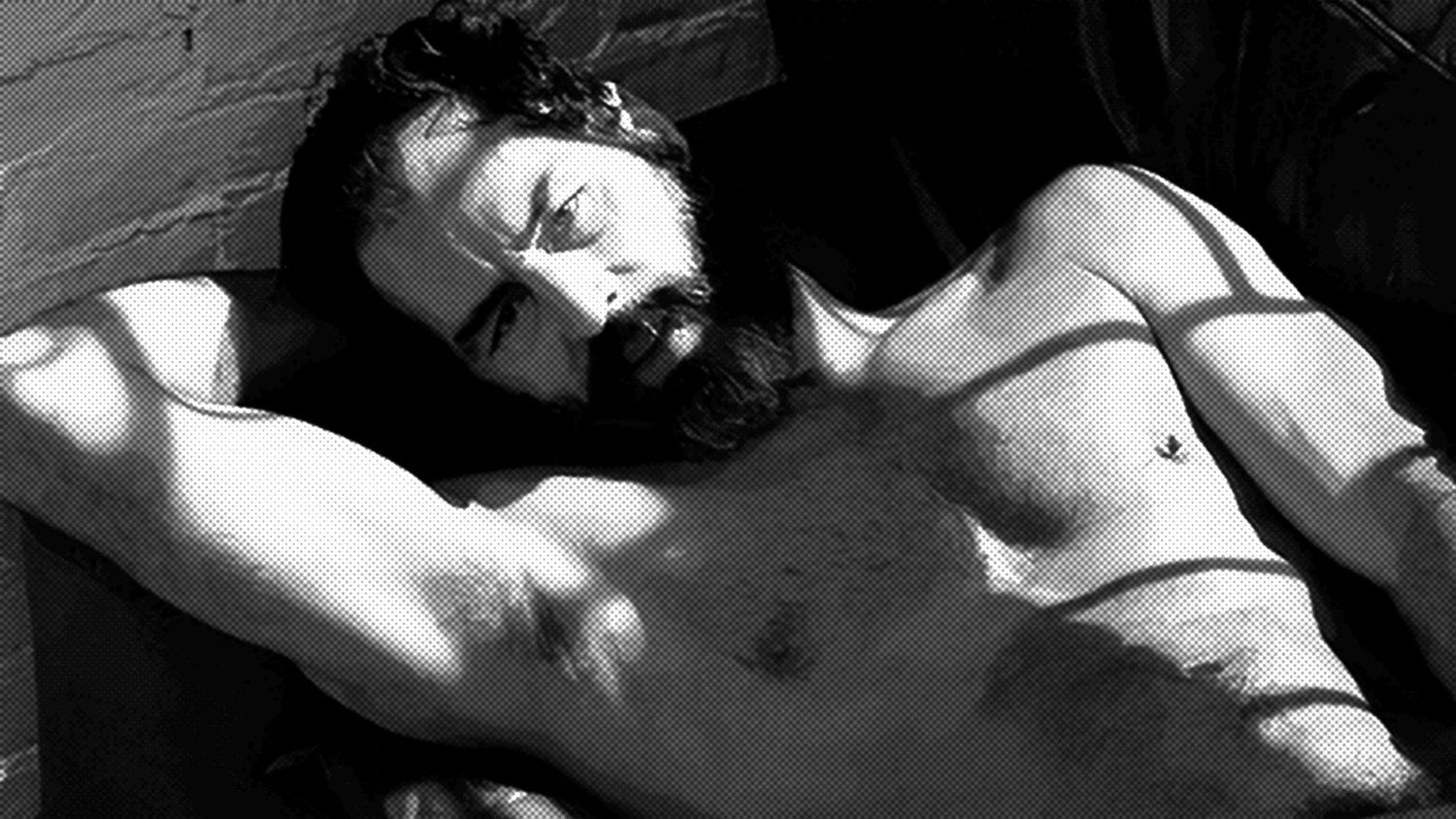
In the 1970s, Richard Locke put his real name, and a rugged, mature vision of gay masculinity, on the screen. When AIDS arrived, he turned that visibility into education, advocacy, and care.
Two kinds of hero
I keep a running list of men I wish more of us knew by name. Richard Locke sits near the top.
If you came up in the right decade, you knew him as Hank, the trucker with the black mustache and the shoulders, working his way across America in three of the most influential gay films ever made. A decade later you might have found him working transmission facts into a live sex show. Or writing a safer-sex column that a gay newspaper ran on page one under the words "Porn Daddy." Or on the AIDS ward at San Francisco General, giving massages to men whose own families had stopped touching them.
People love to frame that as a redemption arc. It isn't one. Both halves of his life came from the same conviction: that gay men are entitled to talk out loud about our bodies, our desires, our health, and our lives. He said it plainly to his brother in 1978, when Blueboy asked why he'd never taken a stage name.
"I'm gay and I'm proud, proud enough to use my name on everything I do, because I feel good about what I do, and I do it well."
Before the movies
Richard Holt Locke was born in East Oakland in June 1941, to a mother who was the daughter of a Pentecostal Holiness preacher. He did three years in the army in Germany as a tank mechanic, then went to Chico State, where he majored in what he called the History and Aesthetics of the Film and threw himself into gay liberation. San Francisco came next, and the Golden Gate Gay Liberation House.
He also had a straight job in insurance, and he stayed closeted in it. By his own account, rumors reached his employer in 1970 and he was fired. Years of education wiped out in an afternoon.
So he left. He landed in the desert outside Palm Springs, built a geodesic dome, wired it to a windmill he'd put up himself, and worked as a licensed masseur and solar designer. That dome shows up in his films. When his brother sat him down for the Blueboy interview, Richard wanted to talk about solar energy, and Bob had to keep steering him back to pornography.
That's the part people flatten. Porn didn't lure him away from a respectable life. Respectable life had already thrown him out for being gay. Porn offered a public existence where being unmistakably queer was the asset.
"I've been looking for you"
The discovery story is pure 1970s. A friend turned up at his house and said he was casting a film and needed hot men. Locke played an Oklahoma patrolman in a feature-length 16mm picture called Dreamer, which he always described as his first. (Databases also put him in Arthur J. Bressan Jr.'s Passing Strangers the same year, in a minor role, so the chronology has never quite settled.)
Dreamer got a real ad budget. Posters of Locke went up across the New York subway. Joe Gage saw one, came back to the West Coast, tracked him down, and brought him to producer Sam Gage. That's how a man who built solar houses in the desert became Hank.
Becoming Hank
The Working Man Trilogy is Kansas City Trucking Co., El Paso Wrecking Corp., and L.A. Tool & Die, released across roughly 1976 to 1979. Hank drives through all three.
What made them land was that they were movies. Recurring characters, highways, job sites, motels, the whole industrial middle of the country. Locke understood exactly what he had. "You have to take a look at the character of Hank and see he is much more than what is seen in the orgy scenes," he told Blueboy. "He's a person. He and Gene share a camaraderie like Butch Cassidy and the Sundance Kid. I don't think you've ever seen that in a porn film before."
He also understood the business. He explained the Gages' three objectives to his brother like the film student he'd been: build a production name people trust, build stars the way Hollywood built Mary Pickford, and make a damn good film. Kansas City got reviewed in the San Francisco Chronicle, a straight paper reviewing a gay porn film. The review was lukewarm. That it existed at all was the point.
Then there were the men. Joe Gage described his casting philosophy without any romance about it: he wanted performers who read as "the average, ordinary, for the most part, working-class citizen." The Gage Men were hairy, thick, adult, and recognizably employed. Locke's Hank was mature instead of boyish. Masculine without the tired pretense of being secretly straight. Confident and also warm, funny, a little bashful. And he lived in an American working-class landscape gay men had been erased from entirely.
Beyond Hank
Reduce Locke to one director and you lose him.
In Wakefield Poole's Take One, a film Poole called a docu-fantasy, Locke appears with Alex, his actual lover, at their actual desert home. Bob Locke told his brother that watching it felt like walking into a room where only the two of them belonged. Richard's answer is the whole man: "I think it was a wonderful expression of my love for Alex, a way to share my love with Alex and let other people know that love does exist and is being spread around, because there's not enough love shared in the world. That's one reason I like doing pornographic movies. I'd much rather be up on the screen fucking and sucking than shooting and killing."
Then there's Forbidden Letters, made with Arthur Bressan Jr. over roughly three years. Locke plays Richard, the older, incarcerated lover of a younger man named Larry. It's explicit and it's a love story, built out of separation and letters and waiting. Robert Adams, who played Larry, has said Locke was quiet and gentle in person, nothing like the poster image, and that the affection between them is why the film works. Restored decades later, it gets discussed as a gay romance, which is what it always was. Bressan went on to make Buddies, the first narrative feature about AIDS. Locke isn't in it, but the two belonged to the same small group who decided gay life, gay love, and eventually gay death were worth serious cinema.
The erotic older man
Here's where this gets personal for me, and for anyone reading this who's over forty and still gets told, in a hundred small ways, that the party moved on without them.
Locke was 37 when Drummer built a feature around him in 1978. Jack Fritscher, who ran the magazine and conceived the piece, has since called it the first gay-liberation-era treatment of older men as objects of erotic glorification, the first "daddies." What audiences saw was body hair he hadn't removed, gray coming into his mustache, a big body he'd never lifted a weight for, and a face that had clearly been somewhere. He talked about all of it without a shred of apology, and he saw where the culture was heading before it got there:
"There'll be a place for us as Daddies as porn films will go on. Why is it that people think that older men don't have sex? Some people have sex into their eighties and nineties."
BEAR magazine later called him "the original porn daddy," and that's the honest way to put it: a later description, not a coronation. Daddy imagery and bear culture came out of a tangle of leather, clone, working-class, and body-hair aesthetics that no single man invented. What's defensible is this. Richard Locke was one of the earliest and most visible erotic embodiments of the mature, hairy gay man, at a moment when the alternative on offer was a smooth twenty-two-year-old. He made forty look like an arrival.
One honest tension alongside that: daddy imagery can push back on ageism and quietly rebuild a pecking order of masculine authority at the same time. Both are true. Locke's version, at least, ran on generosity.
Allan
He told this part himself, on the front page of the Bay Area Reporter, in February 1985.
On April 30, 1983, he was at Madison Square Garden for what he called the largest gathering of gay men ever assembled under one roof: a Ringling Bros. circus benefit for Gay Men's Health Crisis. He was in New York to work and live with Allan Noseworthy III, who sat on the board of the AIDS Resource Center. They became, in Locke's careful phrase, lovers of a sort. Allan followed him out to Palm Springs that November. The next spring Allan was diagnosed with Kaposi's sarcoma, and that June he died.
Before that, the two of them had taken an American Red Cross course on the basic hygiene of caring for people with AIDS. Locke read Michael Callen and Richard Berkowitz's pamphlet How to Have Sex in an Epidemic: One Approach, one of the first safer-sex documents gay men wrote for other gay men. Then he and Allan started improvising, figuring out what a satisfying sex life looked like once you engineered the fluid out of it. They named the result themselves. Sensible sex.
"I feel I owe my life to sensible sex," Locke wrote, and dedicated the essay to Allan, calling him his hero.
He'd been diagnosed himself. He told a friend years later he'd narrowed his own infection down to 1983.
Understand what he had that the health department didn't. He could reach men who wouldn't listen to a doctor, wouldn't sit through a moralizing pamphlet, and had good reason to distrust any gay organization busy proving it was respectable. He knew the language, the humor, and the practices, because they were his. His pornography was the qualification. He said as much: "Everybody loves a daddy, so if I can serve in that capacity to transmit information about good, clean, healthy sex, then I am more than happy to play that role."
Sensible Sex
The seminars were part lecture and part live erotic performance, and they traveled: San Francisco, Los Angeles, Palm Springs, New York. Prevention delivered by the daddy, in a room where men were already turned on. Nobody forgets a lesson learned like that.
The Bay Area Reporter ran his column, marked "First of a Series," across the top of page one on February 21, 1985: "On the Cruise for 'Sensible Sex': Porn Daddy Richard Locke Maps the Route to Lower Risk." A community newspaper put "Porn Daddy" above the fold as a credential.
Read it now and the thing that jumps out is how carefully he refused the word everyone else was using.
"I don't like the term 'Safe Sex,'" he wrote. "The scientists say that the only safe sex is masturbation; anything beyond is merely perhaps safe, or just downright unsafe. I feel we can use the term 'sensible sex,' which means good common sense." And then, because he was honest before he was reassuring: "Sensible sex takes those high-risk activities out of the high risk category and brings them into the low risk category. It must be remembered that low risk is still a risk."
He walked readers through what was known and what wasn't about which fluids carried the thing, said plainly that celibacy was one way to interrupt transmission and that for a lot of men it wasn't a viable one, and then spent the rest of the series on the alternatives. What he would not do is make it sound like medicine.
"The only limit to sensible sex is the imagination. Fantasy, imagination, patience, timing, planning and any number of other things can blend to make a satisfying, caring, sexual encounter without the sterility that is connotated by 'safe sex.'"
In 1987 he collected the work into a book, In the Heat of Passion: How to Have Hotter, Safer Sex, self-published first and then picked up by Leyland Press. A signed copy sits today in UCSF's Guerrilla Clinic archive, where the finding aid describes his position exactly: that people could and should enjoy a healthy sex life while maintaining a vigilant safer-sex standard. A peer-reviewed history in the American Journal of Public Health counts him among the community practitioners who built prevention from inside gay life. He belongs to public-health history as much as porn history.
None of that advice is current. HIV science has been rebuilt from the ground up since, and the conversation now includes testing, treatment, undetectable equals untransmittable, PrEP, and PEP. What survives is the principle: give people accurate information without making them prove they're respectable first.
Hands
The seminars were the loud part. The rest was quieter.
Around 1983 he started showing up on Ward 5B at San Francisco General, the first inpatient AIDS ward in the country. He was one of the original crew around Rita Rockett's Sunday brunches, bringing food and music and dancing onto a floor where the nurses were among the only people in the building willing to touch anyone. He entertained patients. He served food. And he brought his massage training, which is the detail I keep coming back to. A body with AIDS in 1985 was a body people crossed the street to avoid. He put his hands on it.
He also ran experimental drugs up from Mexico and helped distribute them through an underground clinic. UCSF's archives document that whole network, the Guerrilla Clinic, run largely on stubbornness and station wagons. None of those drugs were proven to work, and that isn't the story. The story is a government that left people to die and the ordinary men who drove south because nobody else was going to.
In 1992 the artist Michael Balser made a nine-minute video, An Evening with Richard Locke, intercutting an erotic performance with HIV transmission statistics for North America. Desire wasn't going to politely stop for the epidemic, so the information that saved lives had to go where the desire already was.
Butterfly
By 1995, at a Billy Club gathering in the California woods, he was asking people to call him Butterfly, after the tattoo on his hip, and quietly asking one admirer to please not bring up his films around men who didn't already know. He'd spent his fame freely, and he was done living inside it. He'd still spend it in a heartbeat if it moved a needle on AIDS education.
His last gathering was Labor Day 1996. He was gravely ill, and his father and brother drove him there because he had something to say. In the heart circle, he talked about heroes: the doctors, the nurses, the home health aides, the hospital housekeepers, the visiting masseurs, everyone whose care went unnoticed. Forty or fifty men sat on the grass and understood they were listening to one of them describe everybody but himself.
He died later that month, on September 25, 1996, in Sacramento, at 55. He left behind two unfinished autobiographies. One was called Living. The other was called Dying.
What he left us
Come back to the name.
Decades before any of us had language for personal branding, Richard Locke worked out that a real name creates recognition, and recognition creates community. He wanted the man watching him in a dark theater in a city with no Castro to feel less ashamed of what he wanted. Later he used the trust attached to that same name to ask those men to keep themselves and each other alive.
He made adult, hairy, ordinary gay masculinity visible and wanted. He treated pornography as an expression of gay identity instead of a secret. He refused the false choice between sexual freedom and taking care of your people. He talked to the men polite institutions wouldn't talk to, and when talking wasn't enough he showed up with his hands.
In 1978 he said he hoped the men watching him would think: that's what I want to be like, open and free. He got that. Then his community got sick, and he taught the second half of the lesson. Being free means you owe each other something.
Your turn
Somebody reading this was in one of those theaters. Somebody sat through one of his seminars, or picked up a copy of In the Heat of Passion, or knew a man on the ward who got a massage from a stranger with a butterfly on his hip. Somebody else found these films forty years late, on a bad video transfer, and finally saw a body that looked like theirs.
Whichever one you are, I want to hear it. Drop it in the comments. If Richard Locke's name is new to you and you go looking, come back and tell me what you found. This is the kind of history that only survives because people keep saying it out loud, which is more or less the whole point of the man.
Stay Hunky.
Read more
In his own words
My Brother the Porn Star: An Interview with Richard Locke (Blueboy, December 1978). His brother Robert conducts the interview, which is exactly as strange and wonderful as it sounds. The single best document of Locke at his peak: how he was discovered, why he used his real name, what he thought Hank was, and his prediction about Daddies. Most of the quotes in this piece come from here.
On the Cruise for "Sensible Sex": Porn Daddy Richard Locke Maps the Route to Lower Risk (Bay Area Reporter, February 21, 1985). The full issue, scanned and searchable at the Internet Archive. Locke's column runs across the top of page one and continues on page four. Historical guidance rather than current medical advice, and worth your time anyway for how he talks to the reader.
Richard Locke: A Swirling Dervish. Swedish journalist Pia-Kristina Garde interviewed Locke in 1987, and this short post is what's online of it. She never got the recording or the transcripts back, so she's writing from memory. Brief, and the one line she does quote tells you a lot about where his head was.
The films and the men who made them
Keep on Truckin': An Interview with Joe Gage (Bright Lights Film Journal). Gage on casting "the average, ordinary, working-class citizen," on how tightly scripted the trilogy was, and on Locke as "a real wild child."
"All of My Films Deal in Fantasy": Wakefield Poole interviewed (The Gay & Lesbian Review, 2016). Poole on Take One, including the bit where he explains that filming Locke and his lover on the roof of their desert house was Locke's own fantasy, submitted like everyone else's. A subscriber article, so some of it may be gated.
Arthur J. Bressan Jr. restorations. Forbidden Letters and Passing Strangers, both restored in 2K. The special features include an on-stage Q&A with Robert Adams, who played Larry opposite Locke's Richard.
Drummer magazine, issue 24, September 1978. Jack Fritscher's own contents index for the issue that featured Locke, with his note that the piece was the first gay-lib framing of older men as "daddies." The full text isn't online, so this is a pointer rather than a read.
The AIDS work, in the record
UCSF Guerrilla Clinic Records. The finding aid for the underground network that brought unapproved drugs up from Mexico and passed them along at cost. It holds Locke's booklet, signed to activist Blaine Elswood, and the archivists' one-paragraph summary of what Locke stood for is better than most obituaries managed.
Thomas Blair, "Safe Sex in the 1970s: Community Practitioners on the Eve of AIDS" (American Journal of Public Health, 2017). Peer-reviewed history that places Locke among the community educators who built safer-sex practice from inside gay life.
An Evening with Richard Locke in the Queer Media Database. Michael Balser's nine-minute 1992 video, catalogued with a synopsis. The database's own spelling of the title has a typo, which is how you know it's a real archive.
Remembrances
Richard "Butterfly" Locke at The Billys. Joe Arcangelini's essay is the source of the "two kinds of hero" framing, and the account of Locke's last gathering. Read the comments too.
Queer Heroes, by Robert Locke. His brother on that final heart circle, and on what heroism actually looks like.