


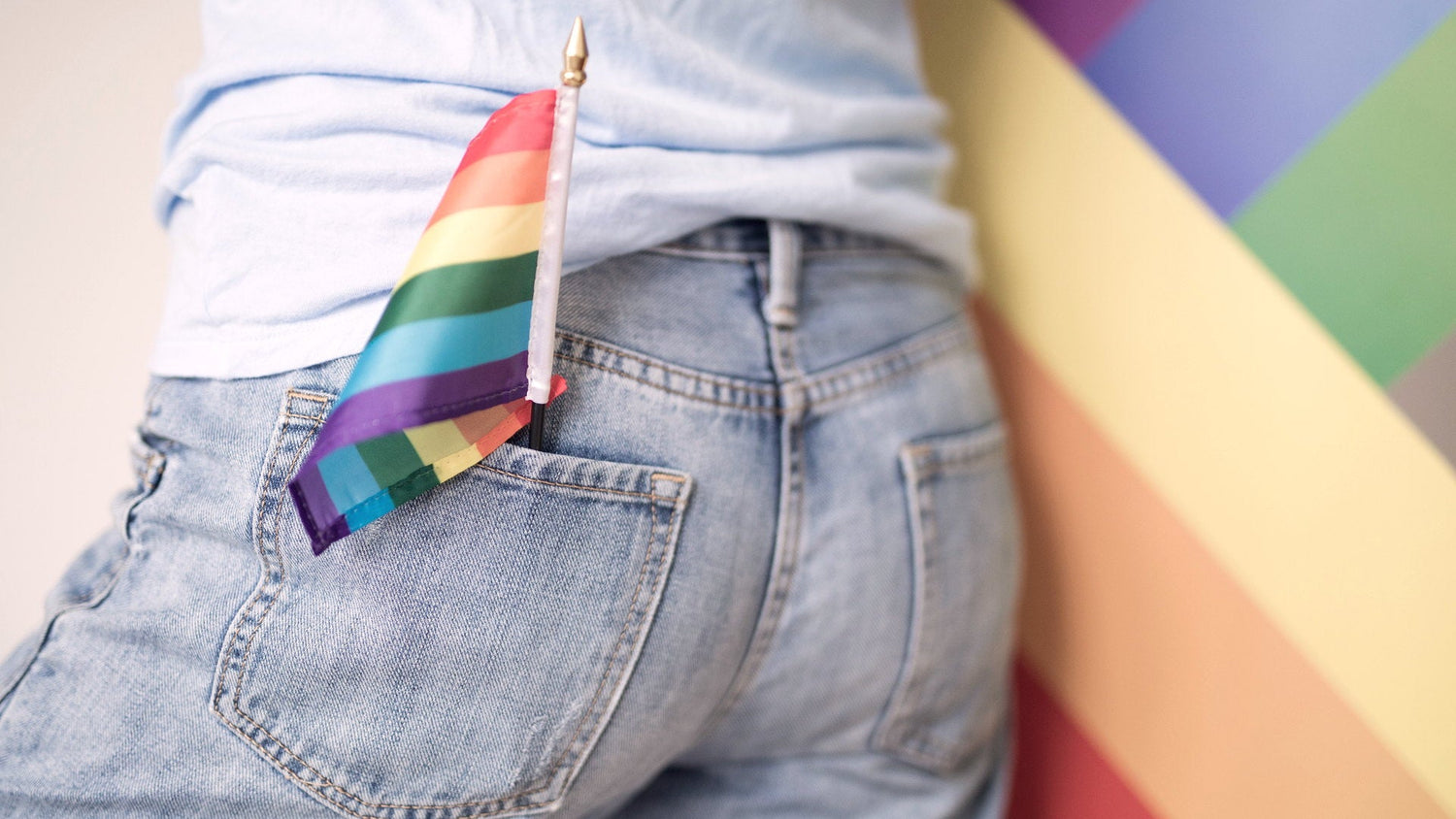
I knew the hanky code existed the way you know a language exists without speaking a word of it.
I could spot a bandana in a back pocket and understand that it meant something. That was the entire extent of my fluency. I picked it up the way you pick up most things at twenty-two, by watching and guessing wrong. By the time I was standing in the kind of places where it would have mattered, it had already gone quiet. Early 2000s, and the thing was functionally a museum piece.
I'll be honest about the rest of it too. I was a guy who noticed, appreciated, and moved on. The leather scene belonged to other men, and I was happy to let it.
Featured product:
But here's what I've come to think about that gap. There's a reason a whole generation of us grew up half-aware of our own vocabulary, and we'll get to it.
First, the part everyone actually came here for.
How to read a hanky, in ten seconds
Two variables. That's the whole system.
The color tells you what he's into. The pocket tells you which side of it he's on.
Left pocket means top. Dominant, active, the one doing the thing.
Right pocket means bottom. Receptive, submissive, the one it's being done to.
So a dark blue hanky in the left pocket and a dark blue hanky in the right pocket are two men looking for exactly each other. Elegant, when you think about it. One glance across a crowded bar and you've covered ground that takes about fifteen messages on an app.
Two slots, though. That was the entire grammar.
Versatile guys had to pick one for the evening. And sides, men who enjoy everything on the menu except anal, had no square on the board at all. Which tracks, because the word didn't exist yet. Dr. Joe Kort coined it decades after the code peaked, and I've written about what a side is and why that identity was never the exception it got treated as.
Hold onto that while you read the chart. This was a system built by one scene, in one decade, around one set of assumptions about what counts as sex.
The colors that actually mattered
There's a version of this chart floating around the internet with sixty-five entries, and I'll get to why that's mostly nonsense in a minute. The list people actually mean when they say "the hanky code" comes from one specific man, and that's worth knowing before you read it.
Larry Townsend was a Los Angeles leatherman who published The Leatherman's Handbook in 1972 and sat down to write the sequel ten years later. From 1980 he ran a "Dear Larry" advice column in Drummer called "Leather Notebook," fielding questions from readers on technique, relationships, and the history of the scene. He was inducted into the Leather Hall of Fame, and thirty linear feet of his papers sit in the stacks at ONE Archives at USC, where you can request a box if you're ever in Los Angeles.
So the man knew what he was talking about. He was also one guy, in one city, in one scene, writing a how-to book with strong opinions and a sharp tongue about anybody outside it. This is testimony from a well-placed witness, and that's the most any of this gets. Nobody was taking a survey.
The Internet Archive has a scanned copy, and the chart runs across pages 26 and 27. Here it is the way he printed it, three columns wide, because the entire point is that one color means two different things depending on which side it's hanging out of.
| Left pocket | Color | Right pocket |
|---|---|---|
| SM topman | Black | SM bottom |
| Fistfucker, top | Red | Fistfucker, bottom |
| Wants to fuck another guy | Dark blue | Wants to get fucked |
| Wants to be sucked | Light blue | Wants to suck cock |
| Wants to give piss | Yellow | Wants to take piss |
| Wants to give scat | Brown | Wants to take scat |
| Hustler, wants money | Green | Wants to hire a hustler |
| Top, anything any time | Orange or multicolor | Bottom, anything any time |
| Top, into piercing | Purple | Bottom, into piercing |
| Bondage topman | Gray | Bondage bottom |
Ten colors. Not sixty-five.
And then it got completely out of hand
Townsend stopped at ten on purpose, and his first reason is so obvious it's almost funny that the internet forgot it.
You can't see color in a bar.
The extra shades, he writes, are "so similar to the basics listed above, it is impossible to discern them in other than bright sunlight." That's the whole problem with the expanded chart in one sentence. A signal you can only read at noon is not a signal. He writes off the rest as "esoteric nonsense," singling out mosquito netting for outdoor sex and zip-lock baggies for drugs.
Then he goes further, and this is the part that genuinely surprised me. Ten colors was already generous. In actual practice, he says, "you seldom see anything other than black, red, dark blue, or yellow, maybe brown."
Five. Written by a man who was in those bars every weekend.
Take that as a report from LA leather bars specifically, because that's where he was standing. But the corroboration is decent. Frank Nowicki, who took the 1993 Mr. Mid-Atlantic Leather title and was going out in the seventies, told Metro Weekly roughly the same thing from the other side of the country: the earliest published codes listed about a dozen options, and men used six or eight. Two witnesses, different coasts, decades apart, landing in the same neighborhood.
The sprawl kept growing anyway. Hornet's modern rundown runs to sixty-five variations, including leopard print, and asks the only sensible question: who could tell orange from coral in a dark bar? Out ran an illustrated set that includes lime green for "looking for dinner, will buy dinner" and silver for starfucker, which I find delightful and completely unusable.
One mechanic nobody mentions: you could wear more than one. A man into heavier action, Townsend says, "could honestly display several colors on either side," though he'd rarely seen more than two, "and always in the same pocket." Same side every time, because your side was the one thing that stayed put. And then the aside that tells you exactly how the orange hanky was regarded: "Not many are willing to go all the way to orange."
He also mentions something worth knowing if you didn't live in a city with a leather bar. Plenty of men flagged in regular bars instead, and he thought it worked. You stand out, and anyone who responds has less competition for your attention.
Townsend's best warning still applies, though. Plenty of men wear a color only because the idea of the hankie turns them on, he says, and the guy with something sticking out of his rear pocket may not even know what it means. Then again, he might. Talk to him. The bandana was only ever an opening line.
Before the hanky, there were the keys
Here's the part that reorganized my understanding of all of this.
The hanky code inherited its left-right grammar from something older.
Before the bandanas, men signaled top or bottom by which side they wore their keys on. Belt loop, hip, hanging off the jeans. Left for top, right for bottom, same as the pocket would later be. And the most-repeated origin story of the hanky code only makes sense once you know that: sometime around 1970, a writer at the Village Voice joked that instead of just wearing keys on one side or the other, men could wear colored handkerchiefs and be specific about what they were into.
The hanky was a software update. The keys were the operating system.
Townsend describes the same thing a few paragraphs before his color chart, and his verb tense is the detail worth catching. "There was a time when keys hanging from the left hip indicated a Topman, whereas those on the right denoted an M." Was. He's writing in the eighties about something already slipping, and he's annoyed about it: guys were hanging keys off their belts because it looked hot, only vaguely aware they were saying anything at all.
He also mentions a fourth signal I'd never heard of. If a man was bare-chested, a pierced left or right nipple could tell the same story. Though even in 1983 he notes that plenty of those were already just jewelry.
Which means that if you're my age and you remember guys with keys clipped to a belt loop, you were watching the older code still running, years after the hankies got the credit. The lesbians kept it going longest, and the beltside key ring turned into the carabiner, which is still with us.
Where it came from, and why nobody agrees
Every origin story for the hanky code is contested, and I've decided that's my favorite thing about it.
The Gold Rush. In the 1850s, San Francisco went from around two hundred people to thirty-six thousand in six years, and almost all of them were men. At all-male dances, a man wearing a blue bandana took the leading part and a man wearing a red bandana took the following part. That's documented as the deep root: colored cloth, left and right, who leads and who follows, a century before anyone called it a code.
The Village Voice joke, around 1970. The one from a few sections back, where a writer suggests men drop the keys and switch to colored handkerchiefs so they can be specific. This is the version you'll see repeated most, and in every retelling the writer is just "a journalist," with no name and no issue date attached. The Saint Foundation's version goes out of its way to specify that it wasn't Michael Musto, which tells you how often somebody guesses wrong.
The Trading Post, a San Francisco erotic-merchandise department store, which started promoting handkerchiefs around 1971 and printing cards listing what each color meant. Red and blue already had meanings. The rest got assigned, essentially, as a sales tool.
Alan Selby, who claimed he and his partners came up with it at Leather 'n' Things in 1972 after a bandana supplier accidentally doubled their order and they needed to move the extra colors. Selby later founded Mr. S Leather, in 1979, so if you've seen him credited as "Alan Selby of Mr. S," that's a few years early.
And my favorite: the hoax theory. A letter to the editor in a 1976 issue of Drummer claimed the whole thing started as a media prank, seeded by a Village Voice piece on S&M, and that the guys who did it were still laughing about it in the press room. Adam Campbell, who wrote a book on leather archives, told Metro Weekly he was never able to confirm it. He also couldn't rule it out.
Gary Wasdin, who runs the Leather Archives and Museum in Chicago, put the whole problem plainly: nobody wrote down "somebody was wearing a hanky at the bar tonight." Marginalized people don't leave tidy paper trails. The silence is the record.
The men who carried it
The hanky belonged to a specific look. Levi's, work boots, plaid, mustache, the whole Castro and Christopher Street uniform I've written about before in Castro Clones: The Look That Built a Movement. Of that entire outfit, the bandana was the part that talked.
And the look traveled further than I'd assumed. Walk into a popular leather bar on a weekend night anywhere in the Western world, Townsend writes, and you'd find "a startling similarity" between the men in New York and Los Angeles, San Francisco and Berlin, London and Munich. Everywhere the same 501 Levi's, leather motorcycle jackets, boots, cowboy hats. The uniform crossed oceans.
Then he punctures the whole thing in the next breath, and I love him for it. In all those bars, most of the men in Levi's and leather, "with keys or hankies giving the promise of their various preferences," turned out "to be complete and utter duds." The real SM guys, he says, were a minority even in the supposed centers of leather action.
Sit with that against the nostalgia. At the height of the code, in the bars where it was spoken most fluently, most of the flagging was just flagging.
We have receipts on the rest of it, too, because somebody thought to document it while it was happening.
In 1977, a photographer named Hal Fischer made a series called Gay Semiotics, photographing the visual codes he was watching operate on the streets of the Castro and Haight-Ashbury. Black and white portraits with the signals labeled right on the print, thin white lines pointing at the evidence. The series lives in the collection at MoMA and at SFMOMA, and you can see the whole thing on Fischer's site.
Twenty-four plates, and three of them are the ones that matter here. Blue Handkerchief, Red Handkerchief. Keys. Earring.
Three codes, running at the same time, on the same street, in the same year.
MoMA's own label on the work notes something I find very funny and very human: Fischer's text explains what the hankies signal, and then points out that the men might also just be carrying something to blow their nose with. A primary source from 1977, already telling you not to over-read it.
So which ear was the gay ear?
Now we get to the thing I actually did grow up with.
Every Gen-X man reading this knows the rule. Left is right, right is wrong. Left ear safe, right ear gay. It got chanted on playgrounds, it got enforced with real menace, and plenty of guys made a piercing decision based on it.
Here's what I didn't know until I went looking. That rule inverts the actual code.
Fischer's 1977 earring plate runs on the same polarity as the hanky and the keys: left for the aggressive, active side. Right for the passive one.
And Fischer has company. Townsend says it flatly in the handbook, in the same passage where he covers the keys: "Probably, but not necessarily, a better indication of active interest is an ear stud, worn in a pierced ear, again, left for Top, right for bottom." His argument is that a man willing to put a permanent hole through his earlobe is more likely to mean it than a man who clipped some keys on before leaving the house.
So that's a San Francisco photographer in 1977 and a Los Angeles leatherman in print, independently describing the same thing. Left for top. Right for bottom.
The playground rule flips it and turns left into the safe, straight side. It's a garbled echo of the real one, picked up secondhand and repurposed by straight boys to police each other.
Whether gay men ever used the earring as a broad, reliable signal is still up for debate. The argument, laid out well by Queer Word, is that if it worked at all it worked in a couple of urban neighborhoods and never functioned as the universal beacon everyone believed in. The rumor went mainstream, panic did the rest, and the version that spread furthest was the version that had the meaning backwards.
Sit with that for a second. My generation learned the fake code fluently and the real one not at all.
What actually killed it
The easy story is that Grindr killed the hanky code. The easy story is wrong, and it's wrong by about twenty-five years.
Usage was already fading by the early eighties. Then in October 1984, San Francisco's public health director ordered fourteen sex venues closed, and a court ruling that November functionally shut the rest. New York followed. You can't flag at a bathhouse that's been padlocked.
AIDS did the rest, in two ways at once. It made anonymous cruising dangerous, and it killed the men who would have taught the code to the next round of us. Then came print personals, then AOL chat rooms, then Craigslist, where you could simply type out what you wanted. By the time the apps showed up, they were finishing a job that was essentially done.
Wasdin's framing of the app era is the most generous one I've read: cruising never went away, it just went digital. Scrolling a grid of small photos looking for someone you like is the same act as scanning a bar, with the internet doing the legwork.
What it means now
The code never fully died, and it's having a real moment again. You'll see the colors at leather weekends, worked into armbands and vest piping rather than hanging out of a pocket. Artists keep reissuing it. An LA collective called Die Kränken designed twelve entirely new hankies and showed them as The New Rules of Flagging.
But the meaning has moved, and this is the part worth carrying out of here. Wasdin said it better than I could. In his words: "if I'm wearing a yellow hanky, it doesn't mean I want to pee on you right now; it's what I'm into in general, and I'm signaling something that is fundamentally a part of me."
The code stopped being a proposition and became a declaration. Which is a very familiar move for us. We do it constantly, across a hundred small signals, most of them louder now than a bandana ever was.
And that generational gap I mentioned at the top? The artist Andy Simmonds named it exactly right when he told Out why he'd spent a year illustrating these colors: there's an entire generation of us who were wiped out by HIV and AIDS and aren't here to pass down what they knew. A lot of us feel that disconnect. A lot of us are looking for ways back into our own history.
That's why this never reached me in a bar in 2003. The men who would have handed it to me were gone.
So I learned it now, at forty-eight, from archives and museum labels and a leather titleholder's interview. That's a poorer way to get it than from a guy at the end of the bar with a beer and forty minutes. It's also the way that's still open, and I'll take it.
If you were there, and you flagged, and you remember which colors people actually wore in your city, I want to hear it. The comments on this one matter more than usual. Some of this history only exists in the heads of the men who lived it, and every time one of you writes it down, a little more of it survives.
The rest of us are listening.
Stay Hunky.