

I knew the name Al Parker long before I knew the face. I couldn't tell you where I first heard it. It was one of those names that was simply around, already famous by the time it reached me.
That changed with Timberwolves, a COLT scene where he co-stars with Mike Davis, which is where I finally put a face (and the rest) to the name. In my piece on Jim French I said I saw the COLT watermark long before I knew the man behind it. Parker went the same way for me: the name first, the man much later.
Then there's The Other Side of Aspen, which is a classic for a reason. But the Parker I keep coming back to is the one behind the camera, running his own studio and making the artier films, like Turned On in 1982.
Most of what's written about Parker stops at the beard and the fame. He was also a businessman who built a studio with the man he loved. After AIDS took that man, Parker spent his last years arguing for safe sex on screen. He told that story himself, in three magazine interviews spread across nearly a decade, so I'm going to let him tell it.
Andrew Okun, from outside Boston
Al Parker was born Andrew Robert Okun on June 25, 1952, and grew up in a middle-class suburb of Boston. In a 1984 interview with Mandate, he gave the place a one-line review: "We lived in a suburb where the kids were so boring they never even jerked off."
His mother was the first entrepreneur in this story. She took a job soldering transistors to boards at an electronics firm. Working 20-hour days, she owned the company within five years. She died of cancer at 43, in 1969, while he was still in high school.
His father found out about his son's career by accident. Walking through an adult bookstore on the way to the straight section, he spotted his son's face on the cover of a gay magazine. That's how he learned his son was a star and gay in the same moment. "It didn't bother him in the least," Parker said.
Parker had other plans first. On New Year's Eve 1979, in an interview for Skinflicks, he said: "Damn, if anyone had told me five years ago when I was going to Boston University Medical School that I was going to wind up in the pornography business, I would have told him he was insane!"
Name That Tune, and a beach in California
How he got into the business sounds made up. He'd lost a job and needed to earn $350 more to qualify for unemployment, so he went on the TV game show Name That Tune. He won. One of the prizes was a trip for two to New York, and he took a woman he'd just met on the beach. He was 22, and in his words, he "desperately wanted to be straight."
She turned out to be bisexual. When he explained his crisis, she said, "Don't worry about it, honey," and the two of them spent the trip picking up men in the Village and feeding them on the game show's money. He came home sure of himself: "I decided that this was what I wanted to do, what I wanted to be, and I didn't give a shit who knew it."
Two days after he got back, he met Steve Taylor on that same beach. They stayed together for the rest of Steve's life.
Then came COLT. "I had always jerked off to the Colt brochures when I was in high school," he said. "I lived in the middle of nowhere and mail-order sex was my salvation." A friend knew the owner and set up a meeting. COLT thought he was on the skinny side, but they took a chance on some test shots, which paid him "a fast fifty bucks" and led to a Playguy cover and a Mandate centerfold.
COLT's own ad copy hedged its bets. Parker remembered it word for word: "This isn't what we usually bring you, but you might like it . . . it might grow on you." His summary: "they apologized for my very existence."
Jim French, working as Rip Colt, is the one who gave him his stage name. Parker's take on it: "I never chose it! I hated it! It sounded real forgettable to me." He never found out what "Al" was short for. He guessed Alexander, or maybe Alan, and made his peace with it: "it's very waspy, and I always wanted to be a WASP."
Hollywood
He'd come to California hoping for legit film work. For a while he was Hugh Hefner's "video technician" at the Playboy Mansion, a job that came with a suit he hated, including a tie "with Bunnies all over it." He also worked behind the scenes for Allan Carr on Can't Stop the Music.
Then Inches opened in New York while that movie was in production, and Parker's face went up "on every lamppost in the city." Carr got angry about the publicity, and Parker quit. He got the last word at the box office: "My picture played for a year." Carr's, by Parker's count, lasted two weeks.
The lesson he took from Hollywood fits in one sentence: "once you've done porno, they don't ever get past your dick."
The look
By 1984, Mandate was calling him "the prototype" of his look. You know it even if you've never seen one of his films: the full beard and mustache over a gym-built chest and a pair of jeans. It's the same uniform I wrote about in Castro Clones: The Look That Built a Movement, and Parker wore it better than almost anyone.
He was practical about the body. "I work out because my body is the only thing I can really control," he said, and he admitted he hated the gym. He'd rather read or work on his photography.
He was practical about the clothes, too. Asked in 1979 how he dressed for public appearances, he said: "This is it! The old jeans and T-shirt." He described walking down Sixth Avenue in his leather flight jacket, passing men in gray flannel suits, and realizing that the T-shirt and tight jeans were his business suit. As a guy who makes T-shirts for a living, I'll take that.
The Other Side of Aspen came out of that same look. Falcon released it in 1978, directed by Matt Sterling, and it became Falcon's best-selling release up to 1993, at about 45,000 copies. Like I said, a classic for a reason.
Surge Studio: two lovers and a P.O. box
The Skinflicks interview caught the moment Parker and Steve went into business. "Steve and I are partners . . . lovers . . . everything . . . he's just so wonderful," Parker said. "We're starting this business very slowly, making sure we do everything right. We learn by doing things twice; we can't afford to do them three times."
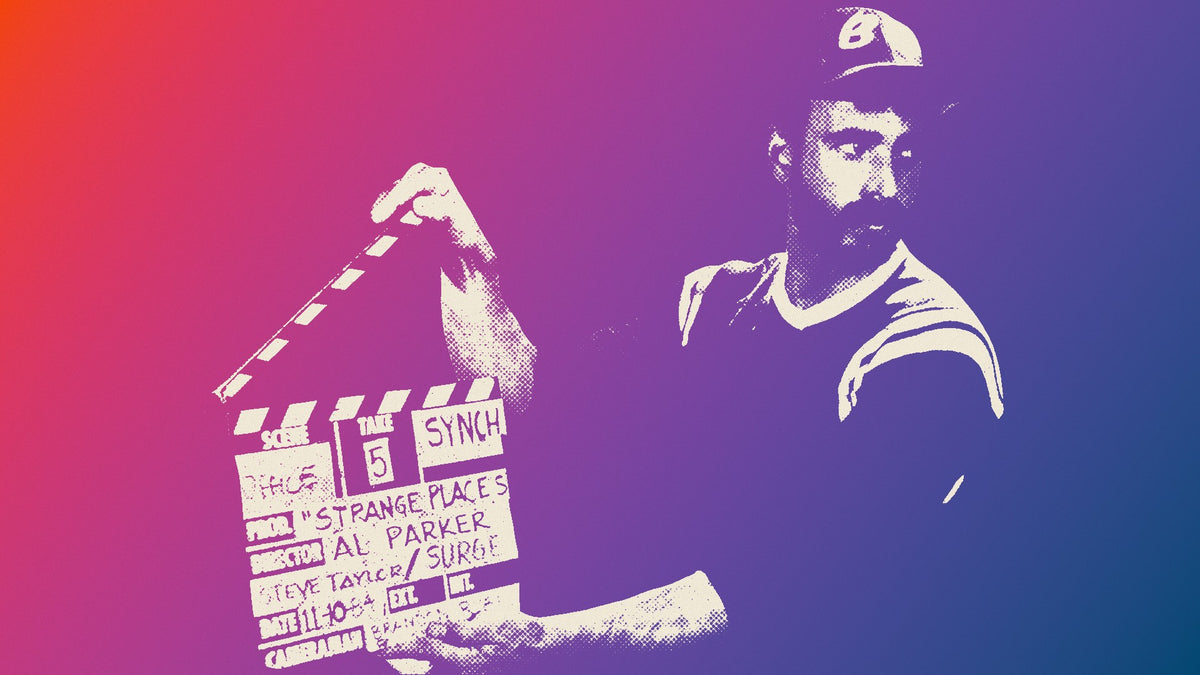
The business was Surge Studio, and it started as mail order, run out of P.O. Box 624 in Hermosa Beach. Parker had watched Inches make big money and figured out early that home video was where it was at. So he agreed to star in Wanted for next to nothing, on one condition: he got to sell the tapes by mail and keep the rights to the stills for his own magazine. "Why not start my own company and not rely on the Alan Carrs?" he asked.
They shot many of the films at their home in Hermosa Beach. By 1984 Parker told Mandate, "Actually, my lover Steve and I do everything." They even made up names for the crew credits "so that it doesn't seem like the same people are doing everything." The two of them shot the magazine stills themselves. On the side, Parker also ran a wallpaper removal business in Los Angeles.
"I always thought of myself as a businessman," he said. "I always knew that acting in front of a camera would at some point enable me to get behind it."
He had firm rules as the boss. On casting: "I interview him. I don't touch him. This is strictly business. I don't take advantage of anybody because I was a model and I know that I didn't want to be taken advantage of." He was a film snob, too: "I will never shoot in video." Sex on film, he said, "is a very fragile and fleeting commodity."
This is where my favorite Parker lives. Surge also made artier films, and Turned On, from 1982, is the one I love most. Parker knew he was trying something. "I try to have something different in each film," he said in 1984. "That scene with Scott Taylor in Turned On should be a classic piece of film."
For all that, he had no illusions about the money. He called himself "a cult hero," which by his definition meant "an insolvent movie star."
The soundtracks
Surge even had its own sound. In the early '80s, Spider Taylor was working at Basic Plumbing, a West Hollywood sex club, when he met Parker, who recruited him to score a film. In 1985 and 1986 Taylor composed the soundtracks for five Surge films. In February 2026, Dark Entries reissued the music as Surge Studio Music on LP and CD, so you can hear what a Surge film sounded like without the film.
The AIDS years
Parker saw the change coming early. By 1981, he told Manshots in 1988, he was "well aware that something bizarre was starting to happen." He stopped the Quaaludes and the cocaine and changed his sexual habits. In the 1984 Mandate interview he was already saying that gay pop culture "is not what it was because of AIDS," and that people had "realized that it's either change or die."
Steve Taylor died on September 9, 1986, at 46. Parker told the story to Manshots two years later. They were on vacation when Steve developed a bronchial condition he couldn't shake. A pill lodged in his throat and burned a hole in his esophagus, and he could no longer eat or breathe properly. "Finally, on a Friday, out of the blue, he was diagnosed as having AIDS. And four days later he died in my arms."
They'd been together "thirteen . . . nearly fourteen years." Everything was shared, down to an El Dorado they'd bought together and the business itself. "No amount of time could have prepared me," Parker said.
When the same interviewer spoke to him in 1986, shortly after Steve died, Parker was sure he was done with film, as an actor and as a producer. Friends kept calling with dinner invitations, and he kept saying no. Then one night he said yes on the spot, and when he hung up, it hit him: "for the first time in thirteen and one-half years, I'd said yes to something without first shouting, 'Hey, Steve.'" He called that moment the beginning of his new life.
He went back to work, and he went back with a cause. He tried to recut A Night Alone with Al Parker, a compilation of older footage, into a safe-sex film with on-camera narration. Distributors refused it. They told him he was "hitting the viewer over the head with a message he didn't want to hear." So he recut it again without the message and released it anyway, knowing he'd "get a lot of flak" for a film that "seems to endorse unsafe sex." His next film, Turbo Charge, was his answer: "What I tried to do was a hot film that was also a safe film, and I think I've accomplished that."
He had no patience for the industry's half measures. Porn was changing, he said, "only to what the market demands." For a long while, he'd been arguing "that the sex practices shown on film must be safe."
He closed that 1988 interview with this: "I believe that properly used, my experience and visibility could now make me a powerful voice for safe sex. I'm doing my best to fulfill my responsibility."
If you've read Remembering Richard Locke, you know Parker had company in that fight. Al Parker died of complications from AIDS on August 17, 1992. He was 40.
What he left
There's a full biography, Roger Edmonson's Clone: The Life and Legacy of Al Parker Gay Superstar (Alyson, 2000), and playwright Drew Sachs wrote a play about his life, aka Al Parker. And Brian Ferrari deserves a thank-you for collecting the interview pages that made this piece possible.
Remember "mail-order sex was my salvation"? When it was his turn, mail order is exactly what Parker built. It's the same world I wrote about in Bob Mizer's Secret Code, and Parker went from the brochures to running a mail-order studio of his own.
What stays with me most is how far the man was from the image. He said in 1988 that he wasn't "Al Parker" at home: "even my name is different. I'm quiet and hard working." He worried about it: "Sometimes, because I'm so completely different from my screen image, I worry that people won't like me, that I won't live up to what they expect me to be."
I knew the name first and the face second. It took three old magazine interviews to meet the man.
Now you. Where did you first come across Al Parker? A tape, or a magazine somebody passed around? Tell me in the comments.
Stay Hunky.
Frequently asked questions
Who was Al Parker? Al Parker (born Andrew Robert Okun, 1952 to 1992) was a gay adult film star who became famous through COLT and Falcon in the late 1970s, then ran his own studio, Surge, with his partner Steve Taylor.
What was Surge Studio? Surge was the mail-order film and magazine company Parker and Taylor started at the end of the 1970s, based in Hermosa Beach, California. Many of its films were shot at their home there.
What does the "Al" in Al Parker stand for? Parker never knew. The name was assigned to him, and he wondered whether it was short for Alexander or Alan.
How did Al Parker die? He died of complications from AIDS on August 17, 1992, at 40. His partner, Steve Taylor, had died of AIDS in 1986.